The Architecture of Arrival: Collapsing the Transit Deficit
A Technical White Paper on Somatic Engineering and the Science of Presence
Author: Grace Olayiwola, M.S.
Subject: Somatic Architecture / Human Systems Integration
Classification: Proprietary Methodology (Briefing 001)
Abstract
In the age of high-velocity transit, the luxury travel industry has prioritized the logistics of movement over the biology of arrival. While aviation technology and concierge services have mastered the art of moving a physical body across the globe in record time, they have largely ignored the inherent "system lag" of the human nervous system.
This briefing introduces the concept of the Transit Deficit—the period of biological desynchrony that occurs when the physical body outpaces the nervous system’s ability to integrate with a new environment. This paper explores the "Architecture of Arrival" as a somatic framework designed to refactor the guest experience, achieve Kinetic Deceleration™, and ensure that the biological self-arrives simultaneously with the physical self.
I. Defining the Crisis: The Transit Deficit
The modern traveler is a victim of a biological paradox. We possess the technology to breakfast in DC and dine in Santorini, yet our internal "operating system" is still calibrated to the humidity, barometric pressure, and light-frequency of the Chesapeake Bay.
This desynchrony is what I define as the Transit Deficit.
For the high-performance individual, time is the ultimate luxury. Yet, the first 48 hours of any luxury journey are often "lost" to this deficit. Even in a first-class cabin or a five-star suite, the traveler experiences a state of Protective Rigidity—a lingering "fight or flight" response triggered by the pressurized cabin, artificial recycled air, and the sheer velocity of displacement. They are at the resort, but their nervous system is still in transit. Until this deficit is collapsed, the luxury amenities provided by the destination remain "ghost features"—incapable of being fully processed or enjoyed by a dysregulated system.
II. The Informatics of Displacement
As an Application Senior Business System Analyst, I view the human body as the ultimate high-stakes system. When we travel, we are effectively attempting a "hot migration" of data (the self) from one server (the origin) to another (the destination) without shutting down the system.
From a Health Informatics perspective, the Transit Deficit is a failure of system-sync. We can measure this through three primary data points:
1. Circadian Desynchrony (The Clock Speed)
The molecular clocks in our cells operate on a 24-hour frequency. When we move across time zones at 500 mph, we create a "read/write error" in our biological code. The body continues to produce cortisol and melatonin based on the "Legacy System" of the origin, leading to cognitive fog and metabolic stall.
2. Heart Rate Variability (HRV) and Autonomic Tone
Transit is inherently stressful. The low-frequency hum of a jet engine, the lack of grounding, and the proximity to strangers keep the Vagus nerve in a state of low-level alarm. A somatic audit of travelers often shows a suppressed HRV—a sign that the nervous system is "bracing" rather than "integrated."
3. Proprioceptive Lag
Our bodies use sensory inputs—the scent of the air, the texture of the ground, the sound of local birds—to determine where we are. In transit, these inputs are replaced by sterile, synthetic environments. When we arrive, the brain experiences a "lag" as it attempts to map a new sensory landscape onto a fatigued system.
III. The Architecture of Arrival: A New Framework
To collapse the Transit Deficit, we must move beyond "Hospitality" and toward Somatic Architecture. This is the intentional engineering of the environment and the persona to facilitate a rapid systemic reset.
The Architecture of Arrival is built on three technical pillars:
Pillar 01: Sensory Infrastructure (The Environment)
The destination must act as a "Somatic Anchor." It is not enough for a room to be beautiful; it must be biologically resonant.
Acoustic Engineering: Moving beyond "quiet" to "resonance." Utilizing neuro-acoustic soundscapes that mirror the frequency of the local environment to force the brain out of "Transit Mode."
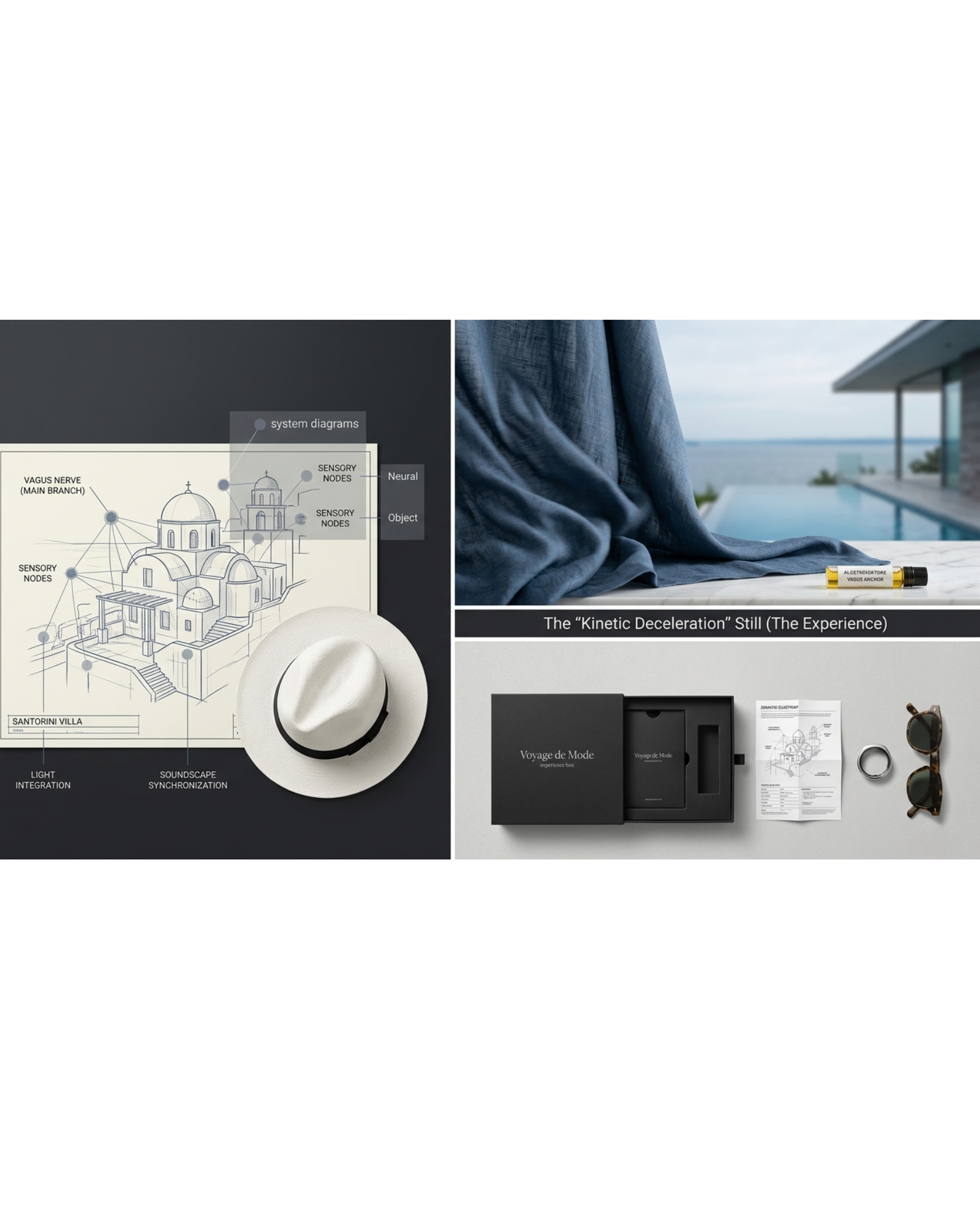
Tactile Grounding: The use of specific materials—heavy stone, raw silk, cool linen—that provide the skin’s receptors with high-fidelity sensory feedback, signaling to the brain that "movement has ceased."
Pillar 02: The Somatic Shield (The Persona)
We must architect the traveler’s external infrastructure—their wardrobe. As a Destination Stylist, I advocate for the Somatic Shield. This is a curated silhouette designed with "Functional Grace." The shield uses fabric weight and compression to provide a constant "tactile hug" to the nervous system, reducing the "bracing" effect of travel. By wearing the right architecture, the traveler carries their own "safe environment" with them, reducing the depth of the Transit Deficit before they even land.
Pillar 03: Kinetic Deceleration™ (The Protocol)
Arrival should not be passive; it should be an active "System Update." Kinetic Deceleration is the practice of intentionally slowing the body’s internal tempo to match the destination. This is achieved through transdermal mineral protocols (magnesium/salt), specific breath-work architectures, and the "Arrival Ritual"—a 15-minute systemic reset that tells the body: The journey is over. The presence is here.
IV. Case Study: The Eastern Shore vs. The Aegean
Consider two high-velocity travelers. One is heading to The Inn at Perry Cabin on the Maryland Eastern Shore; the other to a villa in Oia, Santorini.
The Somatic Architect does not treat these journeys the same.
For the Eastern Shore: The environment is maritime, humid, and low-frequency. The Architecture of Arrival involves heavy knits, cedar scents, and grounding on the marshland to sync the body with the slow "tide-rhythm" of the Chesapeake.
For Santorini: The environment is volcanic, high-contrast, and high-frequency. The Architecture of Arrival involves crisp linens, citrus-based neuro-scents, and mineral-heavy hydration to buffer the system against the intense Aegean sun and the steep, vertical proprioception of the caldera.
By tailoring the "Hardware" (the clothes and products) to the specific "System Specs" of the destination, we collapse the Transit Deficit in hours rather than days.
V. The Business Case: Sleep ROI and Guest Loyalty
For the luxury hospitality industry, the Transit Deficit is a hidden drain on revenue. When a guest spends their first two days in a state of "Protective Rigidity," they are less likely to book spa treatments, less likely to dine at the signature restaurant, and more likely to leave a "lukewarm" review.
By implementing Somatic Residencies, properties can offer a measurable Sleep ROI. When a resort integrates the Architecture of Arrival into their guest journey, they aren't just selling a room; they are selling a systemic reset. A guest who arrives and immediately enters a state of Functional Grace is a guest who becomes a lifelong advocate for the brand.
VI. Conclusion: The Future of Presence
The future of luxury is not found in more "stuff." It is found in the precision of the experience.
As we move toward 2026 and 2027, the demand for Somatic Architecture will only grow. High-performance individuals are no longer satisfied with just "being somewhere"; they want to be present there.
Collapsing the Transit Deficit is the first step in that evolution. It is the move from being a "Passenger" to being a "Voyager." It is the transition from "Transit" to "Arrival."
By applying the rigor of Health Informatics and the elegance of Destination Styling, we can finally bridge the gap between where our bodies are and where our souls have landed.
Grace Olayiwola, M.S.Somatic Architect & Business Systems AnalystFounder, Somatic Stylist Studio ---
Architect’s Final Note:In every system, there is a point of optimal performance. In the human system, that point is called Presence. We build the architecture that gets you there.
[Request a Somatic Audit][Explore the Hardware at ALGStudioStore][Join the Voyage de Mode 2026 Waitlist]