The Missing Link to True Nervous System Regulation in Corporate and Clinical Wellness Programs
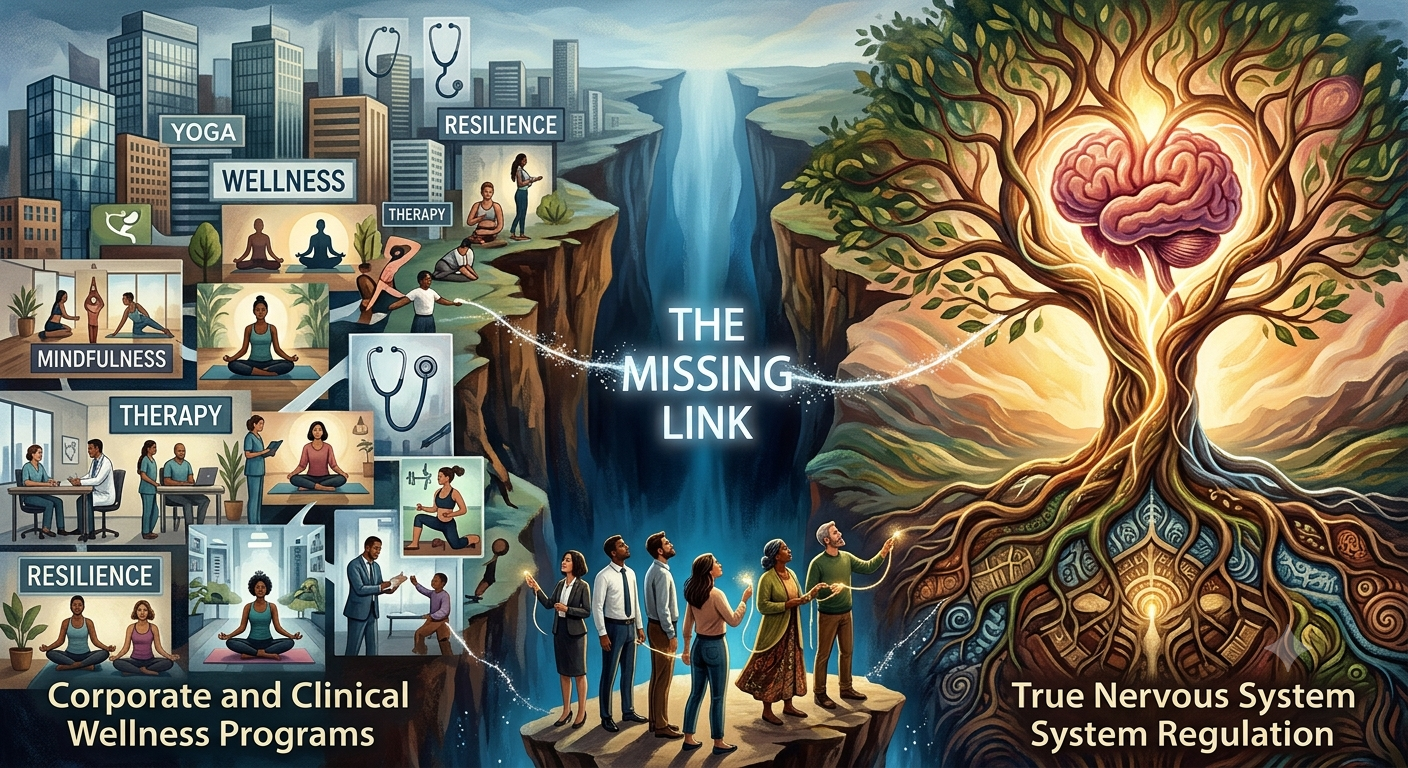
As a Somatic Architect and Health Informatics professional, my daily work involves analyzing the intersection of human biology, data, and environmental design. For years, I have watched organizations pour millions of dollars into wellness initiatives, only to see burnout rates among medical providers and corporate executives climb to unprecedented heights. We are facing an epidemic of chronic dysregulation, and our standard solutions are failing.
The traditional wellness model—a patchwork of meditation apps, annual resilience seminars, and optional yoga classes—operates on a fundamental misunderstanding of human physiology. It treats stress as a software bug that can be patched with a quick mental exercise, rather than a systemic, environmental issue that requires an architectural solution.
This deep systemic failure is what drove me to develop the Somatic Clinical Restoration Sandbox. This program is a clinical-grade intervention that utilizes what I call a "Systemic Bridge" to help medical providers and high-stress professionals transition safely from acute clinical stress to a restorative baseline. But to understand why the Sandbox is necessary, we must first understand why current models are broken.
I reached out to four leading voices in human performance, primary care, somatic practice, and coaching. I asked them one vital question: "In your expert view, what is the most significant gap in current corporate or clinical wellness programs that prevents true nervous system regulation?"
Their answers were illuminating, pointing to four critical missing elements: Repetition, Structural Change, Environmental Predictability, and Biological Individuality.
Here is what they had to say, and how we must radically redesign our approach to wellness to save our workforce.
1. The Missing Element of Repetition: Physiology Learns Through Experience
The first major flaw in our current wellness paradigm is the over-reliance on information over integration. We give employees pamphlets on stress management and expect their autonomic nervous systems to comply. But the body does not speak the language of intellect; it speaks the language of sensation and repeated experience.
Peter Paul Parker, a Qi Gong Instructor specializing in Nervous System Regulation, Stress Recovery, and Emotional Healing at Bright Beings Academy, highlights this exact gap.
"The most significant gap I see in corporate and clinical wellness programmes is that they often focus on managing symptoms while overlooking the state of the nervous system generating those symptoms.
Many programmes provide education, mindfulness techniques, wellbeing resources, or resilience training, yet people frequently remain stuck in chronic stress patterns because the body has not been given enough opportunities to experience and rehearse a regulated state.
In my work as a Qi Gong instructor and Meraki Guide, I regularly meet individuals who understand stress intellectually but still live in a state of hypervigilance, emotional shutdown, or chronic overwhelm. Knowledge alone rarely creates lasting regulation because the nervous system learns primarily through experience rather than information.
One of the most overlooked aspects of nervous system restoration is repetition. Practices such as Qi Gong use gentle, repetitive movement, breathing, and focused awareness to repeatedly signal safety to the body. Over time, these experiences create a new reference point. The nervous system starts to recognise that it does not need to remain in a constant state of vigilance.
What I often observe is that students initially experience regulation only during practice. However, after weeks or months of consistent repetition, something interesting begins to happen. They report finding themselves in the middle of a busy day and suddenly noticing that their breathing is deeper, their shoulders are relaxed, and they are responding to challenges with greater calm. They have not consciously applied a technique in that moment. Instead, the body has started to remember a different way of being.
This is where many wellness programmes fall short. They offer interventions but do not always provide enough repeated embodied practice for regulation to become a learned physiological pattern. Sustainable change occurs when calm is not simply understood as a concept but becomes familiar to the body through consistent experience.
From my perspective, true nervous system regulation is less about teaching people how to relax and more about helping the body repeatedly experience safety until regulation becomes its new baseline. The organisations achieving the greatest success are those that create opportunities for regular nervous system restoration throughout the working day rather than treating wellbeing as an occasional intervention."
The Somatic Architecture Perspective
Parker’s insight is profoundly aligned with the principles of neuroplasticity. When a medical provider spends twelve hours in a state of hyper-arousal—managing life-or-death situations, navigating complex electronic health records (EHR), and dealing with patient trauma—their nervous system establishes a baseline of sympathetic dominance (fight or flight).
You cannot reverse twelve hours of high-stakes sympathetic tone with a fifteen-minute breathing module done once a month. The body requires a rehearsal of safety. This is a core pillar of the Somatic Clinical Restoration Sandbox. We do not just teach a concept; we provide a physical and temporal space where the body can repeatedly engage with the Systemic Bridge, creating micro-moments of autonomic recovery until a regulated state becomes the default, rather than the exception.
2. The Illusion of Add-On Wellness: Changing Conditions Over Adding Apps
The second massive gap in our wellness programs is structural. It is the insidious practice of taking a fundamentally toxic or overwhelming environment and trying to "bolt on" recovery tools, putting the onus of stress management entirely on the exhausted employee.
Anna Evans, Founder of Interlinked Wellness and a leader who runs a primary-care practice, articulates the frustration of clinical staffing brilliantly:
"I run a primary-care practice, so I see this from the staffing and scheduling side rather than from any single intervention. The most significant gap I see is that most corporate and clinical wellness programs are bolted on top of the exact conditions creating the stress, instead of changing those conditions.
You cannot meditate your way out of a schedule that never lets your system stand down. When the workload, the lack of schedule control, and the after-hours documentation load are left untouched, a mindfulness app or a lunchtime webinar becomes one more task on an already full plate. People do not get to downshift, because the day is built so they never can. That is the gap, and it is structural, not motivational.
What I have watched move the needle is small and unglamorous. Protecting 30 minutes of unscheduled buffer in my team's day did more for how people felt than any program we layered on top, because it gave them a moment to recover inside the workday instead of asking them to recover on their own time afterward.
So the question I would put to any wellness program is whether it changes the workday or just decorates it. Real recovery comes from predictability and protected time, not from one more resource people have to find the energy to use."
The Somatic Architecture Perspective
Evans highlights the critical difference between structural and motivational gaps. In Health Informatics, we often look at the data surrounding physician burnout, specifically "pajama time"—the hours spent charting at home after the shift is over. If a hospital introduces a meditation app but does nothing to streamline EHR workflows or adjust patient load, they are not offering wellness; they are offering a band-aid for a hemorrhage.
The Somatic Clinical Restoration Sandbox was designed explicitly to avoid "decorating" the workday. The Systemic Bridge is integrated into the workflow. By functioning as a clinical-grade intervention, it justifies the allocation of protected time. Just as a surgeon must scrub out and sterilize after a procedure, the nervous system requires a mandatory, structural buffer to discharge acute stress before moving to the next task. We must stop asking professionals to recover on their own time using their own depleted energy.
3. The Architecture of Predictability: You Cannot Schedule Regulation
Even when organizations attempt to provide time for wellness, they often misunderstand how the autonomic nervous system actually works. They treat regulation like a meeting that can be scheduled at 2:00 PM on a Tuesday.
Wilson Meloncelli, Human Performance Consultant at Mavericks Consulting and author of The Mechanics of Being, points out that true regulation requires a foundational redesign of environmental predictability.
"The most significant gap is the assumption that regulation can be scheduled.
Current corporate wellness programs treat the nervous system like software that needs debugging. They offer meditation apps, breathwork workshops, fifteen-minute recharge sessions. The implicit model is: apply intervention, achieve regulation, return to work. But the nervous system does not toggle between states on command. It runs continuous prediction loops based on environmental reliability. If the environment signals chronic threat, inbox volatility, unpredictable leadership decisions, back-to-back context switching, no amount of boxed breathing will override the forecast.
The real gap is architectural. Most programs intervene after dysregulation, treating symptoms downstream. They never address the upstream variable: predictability. The nervous system craves coherent patterns. When the workday structure itself is incoherent, meeting rhythms that shift weekly, unclear decision authority, ambiguous success metrics, the autonomic system stays in preparatory threat mode regardless of what recovery tool you hand someone.
True regulation requires environmental redesign, not individual resilience training. That means auditing the actual rhythms of the organization: communication cadence, decision latency, role clarity. The intervention is not what you do to your people. It is what your system does to their predictive models.
'You cannot out-meditate a chaotic environment.'"
The Somatic Architecture Perspective
Meloncelli’s concept of the nervous system as a "continuous prediction loop" is the bedrock of somatic architecture. The brain is an expectation machine. Through a process known as allostasis, the brain constantly predicts the body's energy needs based on environmental cues. If a clinical environment is characterized by chaotic scheduling, ambiguous protocols, and shifting leadership demands, the brain will continuously pump out cortisol and adrenaline, keeping the body in "preparatory threat mode."
This is why traditional wellness is fundamentally downstream. When I built the Somatic Clinical Restoration Sandbox, I realized that the intervention could not just be a physical space or a set of exercises; it had to be a bridge that brought predictability back into the provider's day. The Systemic Bridge functions as a reliable, invariant anchor in an otherwise volatile environment. It creates a coherent pattern that the nervous system can trust, gradually lowering the baseline hum of chronic threat.
4. The Erasure of Individuality: Bio-Individuality and Cultural Context
Finally, even if a program is repetitive, structural, and predictable, it will fail if it treats all human bodies as identical machines. Corporate wellness is infamous for its "one-size-fits-all" approach, entirely ignoring the distinct physiological landscapes of its workforce.
Silvija Meilunaite, Nutrition and Wellness Coach and Founder of Barefoot Basil, highlights how programs ignore vital nuances like hormonal shifts and biological individuality.
"The biggest gap is that most programs treat stress as a mindset problem, not a work culture problem, and offer a quick fix -an app, a meditation subscription, a lunch-and-learn - while the work conditions never change. The body stuck in fight-or-flight does not regulate because someone watched a webinar or subscribed to an app.
The second gap is that these programs are one-size-fits-all. The same generic plan gets handed to everyone, ignoring that stress physiology is not identical from person to person. For women over 40, for example, perimenopause shifts cortisol patterns and wrecks sleep, so the stress response itself is changing - and a program that does not account for that is solving the wrong problem.
Real regulation comes from consistent, body-based habits built into daily life - sleep, movement, time outside, proper recovery - not from an annual wellness initiative. Until programs address the workload and the individual instead of just offering tools, they will keep measuring attendance while nervous systems stay dysregulated."
The Somatic Architecture Perspective
Meilunaite exposes a critical blind spot in modern wellness: the erasure of physiological context. Stress does not impact a 25-year-old male resident and a 45-year-old female attending physician in the exact same biological way. When we ignore factors like perimenopause, shifting cortisol curves, neurodivergence, or even basic circadian rhythm variations, our "solutions" become exclusionary.
Furthermore, treating stress merely as a "mindset problem" borders on gaslighting. It tells the provider that their inability to cope with an unreasonable workload is a personal failing rather than a biological inevitability.
The Somatic Clinical Restoration Sandbox incorporates this understanding by utilizing Health Informatics to track individual biometric responses, allowing the Systemic Bridge to be customized. A regulatory practice that works for one provider (like deep, parasympathetic breathing) might trigger anxiety in another. True somatic restoration requires a menu of body-based, bio-individually appropriate off-ramps from stress.
Introducing the Somatic Clinical Restoration Sandbox: The Missing Link
Having unpacked the severe limitations of current wellness models, it becomes clear why a new paradigm is desperately needed. The collective wisdom of these four experts perfectly frames the problem: We cannot educate, bolt-on, schedule, or standardize our way out of autonomic dysregulation.
This is exactly why the Somatic Clinical Restoration Sandbox was conceived. It is not a wellness program; it is a clinical-grade operational protocol. It sits at the intersection of data-driven Health Informatics and embodied Somatic Architecture.
What is the "Systemic Bridge"?
The core mechanism of the Sandbox is the Systemic Bridge. Think of it as a physiological decompression chamber for the human nervous system. When a deep-sea diver returns to the surface, they cannot do so immediately, or the sudden change in pressure will cause catastrophic damage to their body. They must pause at specific intervals to allow their physiology to adapt to the changing environment.
Healthcare providers and high-level corporate professionals undergo a similar phenomenon every single day. They spend hours in states of high psychological and physiological pressure. Then, at the end of their shift, they are expected to step into their cars, drive home, and immediately transition into being patient parents, loving partners, and relaxed human beings.
The human nervous system does not work that way. The pressure must be systematically released.
The Systemic Bridge is a structured, protected protocol embedded directly into the workflow. It provides:
Repetitive Practice (Addressing Parker's Gap): The Sandbox requires daily, micro-engagements. Providers do not learn about relaxation; they physically practice shifting from sympathetic to parasympathetic states using evidence-based somatic tools. Through daily repetition, the body builds a new, regulated baseline.
Structural Buffer (Addressing Evans' Gap): The Sandbox is built into the schedule. It is protected time. It does not decorate the workday; it alters the architectural flow of the clinic, guaranteeing that recovery happens during the work cycle, not at the expense of personal time.
Environmental Predictability (Addressing Meloncelli's Gap): Because the Sandbox is an operational protocol, it provides an invariant anchor in the day. No matter how chaotic the emergency room or the boardroom becomes, the nervous system knows that the Systemic Bridge is coming. This predictability alone lowers anticipatory anxiety and threat-forecasting.
Bio-Individual Tuning (Addressing Meilunaite's Gap): Utilizing health informatics, the Sandbox respects individual physiology. Providers can choose from multiple somatic off-ramps—whether that is dynamic movement to discharge excess adrenaline, or stillness to combat sensory overwhelm—honoring the biological reality of where their nervous system currently sits.
The Future of Organizational Wellness
We are at a tipping point in corporate and clinical environments. The great resignation, the rising rates of clinical depression among medical professionals, and the sheer exhaustion of our workforce are not signs that people have forgotten how to be resilient. They are signs that our environments are no longer habitable for the human nervous system.
It is time to stop offering mindfulness apps to people who are drowning in structural chaos. It is time to stop treating symptoms downstream while ignoring the upstream architecture.
By implementing tools like the Somatic Clinical Restoration Sandbox, we can transition from superficial wellness initiatives to genuine physiological stewardship. We can build environments that do not just extract energy from our workforce, but actively help them restore it.
The missing link to true nervous system regulation is not a mystery. It is a commitment to redesigning our environments so that safety, predictability, and systemic recovery become the foundational architecture of the modern workday.